
Cashews are one of the more demanding nuts to process. The kernel sits inside a hard shell that contains a caustic liquid, so it cannot simply be cracked like a walnut. The nut also carries a thin skin that must be removed without damaging the kernel. Because of this, cashew processing follows a careful sequence of steps, and the order matters.
This guide walks through the nine steps that turn raw cashew nuts (RCN) into finished, packed kernels. If you want the full system view of how machines are connected, read our complete cashew processing line guide. Here we focus on what happens at each step and why.
Quick Overview: The 9 Steps
- Receiving and cleaning raw nuts
- Calibration (size sorting)
- Steaming and conditioning
- Shelling
- Shell and kernel separation
- Drying
- Peeling
- Grading and sorting
- Packing
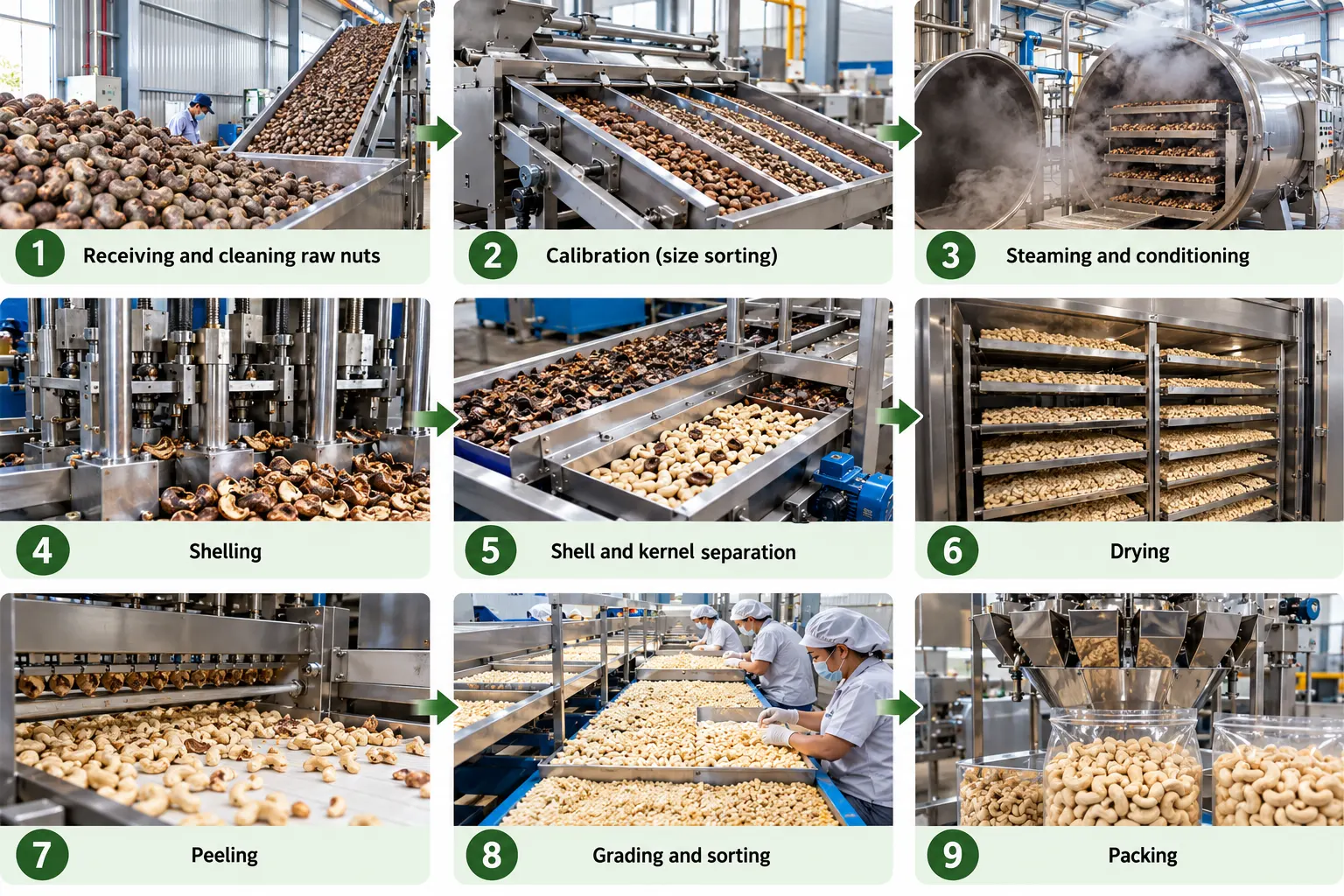
Some factories combine or add steps depending on their equipment and products, but this sequence is the foundation of almost every cashew plant.
Step 1: Receiving and Cleaning Raw Nuts
What happens: Raw cashew nuts arrive from farms or traders. They are checked for moisture, size, foreign material and signs of damage, then cleaned to remove sand, stones, leaves and dust.
Why it matters: Every quality problem in the raw material is carried through the whole line. Wet or moldy nuts cause poor shelling results, and foreign objects can damage machines.
Output: Clean raw nuts ready for storage or for the production line.
Step 2: Calibration
What happens: A calibrator sorts nuts into size groups.
Why it matters: The shelling machine works best when it handles nuts of similar size. Mixed sizes mean some nuts are cut badly, which increases broken kernels and uncut nuts. Calibration is a small step that has a large effect on whole-kernel recovery.
Output: Two or more size groups, each processed with its own machine settings. See our deeper article on the cashew calibrator.
Step 3: Steaming and Conditioning
What happens: Nuts are treated with controlled heat so the shell and kernel are in the right condition for shelling.
Why it matters: Nuts that are too hard or too uneven in condition break kernels during shelling. Stable steaming gives the shelling stage a predictable product to work with.
Output: Conditioned nuts at consistent temperature and moisture. Learn more in our guide to the cashew steaming system.
Step 4: Shelling
What happens: A shelling machine opens the shell and releases the kernel.
Why it matters: This is where most value is won or lost. A well-set machine delivers a high share of whole kernels. A poorly set one produces many pieces, which sell for much less. For selection criteria, see how a cashew shelling machine works.
Output: A mixture of kernels, shell fragments and a small share of uncut nuts.
Step 5: Shell and Kernel Separation
What happens: Shell pieces are removed from the kernels, and uncut nuts are sent back for another pass.
Why it matters: Shell left in the product creates quality complaints and slows later stages. Clean separation also supports recovery of shell as a by-product, such as fuel or cashew nut shell liquid.
Output: Clean kernels still covered with their skin.
Step 6: Drying
What happens: Kernels are dried in a controlled environment, often followed by a stabilizing humidification step.
Why it matters: The brown skin (testa) is easiest to remove when moisture is properly managed. Drying that is too fast can crack kernels, and drying that is too light makes peeling hard.
Output: Kernels in good condition for peeling.
Step 7: Peeling
What happens: The testa is removed from the kernel using mechanical or air-based machines, often with manual finishing for stubborn kernels.
Why it matters: Clean peeling gives the white, uniform look that buyers expect. The aim is to remove the skin without scratching or breaking the kernel.
Output: White cashew kernels, ready to be graded.
Step 8: Grading and Sorting
What happens: Kernels are separated by size, shape and color into commercial grades. Whole kernels, splits and pieces are separated, and defective kernels are removed.
Why it matters: Price depends heavily on grade. Accurate grading protects your margin and builds trust with buyers. A later article in this series explains the common grades such as W180, W240 and W320.
Output: Graded kernels sorted by quality and size.
Step 9: Packing
What happens: Finished kernels are packed according to customer requirements. Many exporters use vacuum packing or gas flushing to protect freshness and extend shelf life.
Why it matters: Cashew kernels can absorb moisture and oxidize if stored badly. Good packing keeps quality stable through storage and shipping.
Output: Packed cashew kernels, ready for sale or export.
Why the Order of Steps Matters
Each step prepares the product for the next one. Changing the order or skipping a step often causes problems:
- Shelling without calibration leads to uneven cutting and more broken kernels.
- Shelling without proper conditioning raises breakage because the shell and kernel are not in the right state.
- Peeling without controlled drying makes skin removal inconsistent and can crack kernels.
- Grading before clean peeling produces unreliable grades because color and appearance are still uneven.
Manual, Semi-Automatic and Automatic Processing
Small processors may do several steps by hand, especially peeling and grading. Larger plants use machines for most steps to improve consistency and reduce labor. A semi-automatic setup is common, where key stages such as calibration, steaming and shelling are mechanized and finishing is partly manual.
The right choice depends on your capacity, labor cost, quality targets and budget. If you are unsure where to start, a supplier with engineering experience can help you plan a line that can grow with your business.
Frequently Asked Questions
How long does it take to process cashews from raw nut to kernel? It varies by factory and equipment. Processing time depends on capacity, the number of manual steps and how well the stages are balanced, so there is no single standard figure.
Why can’t cashews be cracked like other nuts? The cashew shell has a honeycomb structure that holds a caustic liquid, and the kernel is delicate and curved. Specialized steps and machines are needed to open the shell safely without damaging the kernel.
Which step has the biggest effect on profit? Shelling and the steps around it (calibration and conditioning) have the biggest impact, because they decide how many kernels stay whole. Accurate grading is the next most important.
Are cashews raw when they are sold? Most cashews sold as raw are not truly raw in the botanical sense, since the nuts go through heat treatment during processing. The term usually means the kernels have not been roasted or flavored.
Plan Your Processing Steps with TPG Cashew
Every factory has different raw material, capacity and product goals. TPG Cashew designs and manufactures cashew processing machinery in Vietnam and supports customers from planning through installation.
Discuss your processing line or request a quotation to get started.
