
A cashew processing line is a connected system of machines that turns raw cashew nuts (RCN) into clean, graded, packed kernels. Each machine does one job, but the real performance of a plant depends on how well all the stages work together. A strong shelling machine cannot make up for poor calibration, and a good peeler cannot fix kernels that were dried badly.
This guide explains the five main stages of a complete cashew processing line, what each stage is responsible for, and how to plan a line that fits your raw material, capacity and budget. It is written for factory owners, new investors and production managers who want to understand the whole process before choosing equipment.
What Is a Complete Cashew Processing Line?
A complete cashew processing line, also called a turnkey cashew processing plant, covers every step from receiving raw nuts to packing finished kernels. Instead of buying separate machines from different suppliers and hoping they match, you work with one engineering partner who designs the machines, the material flow and the layout as one system.
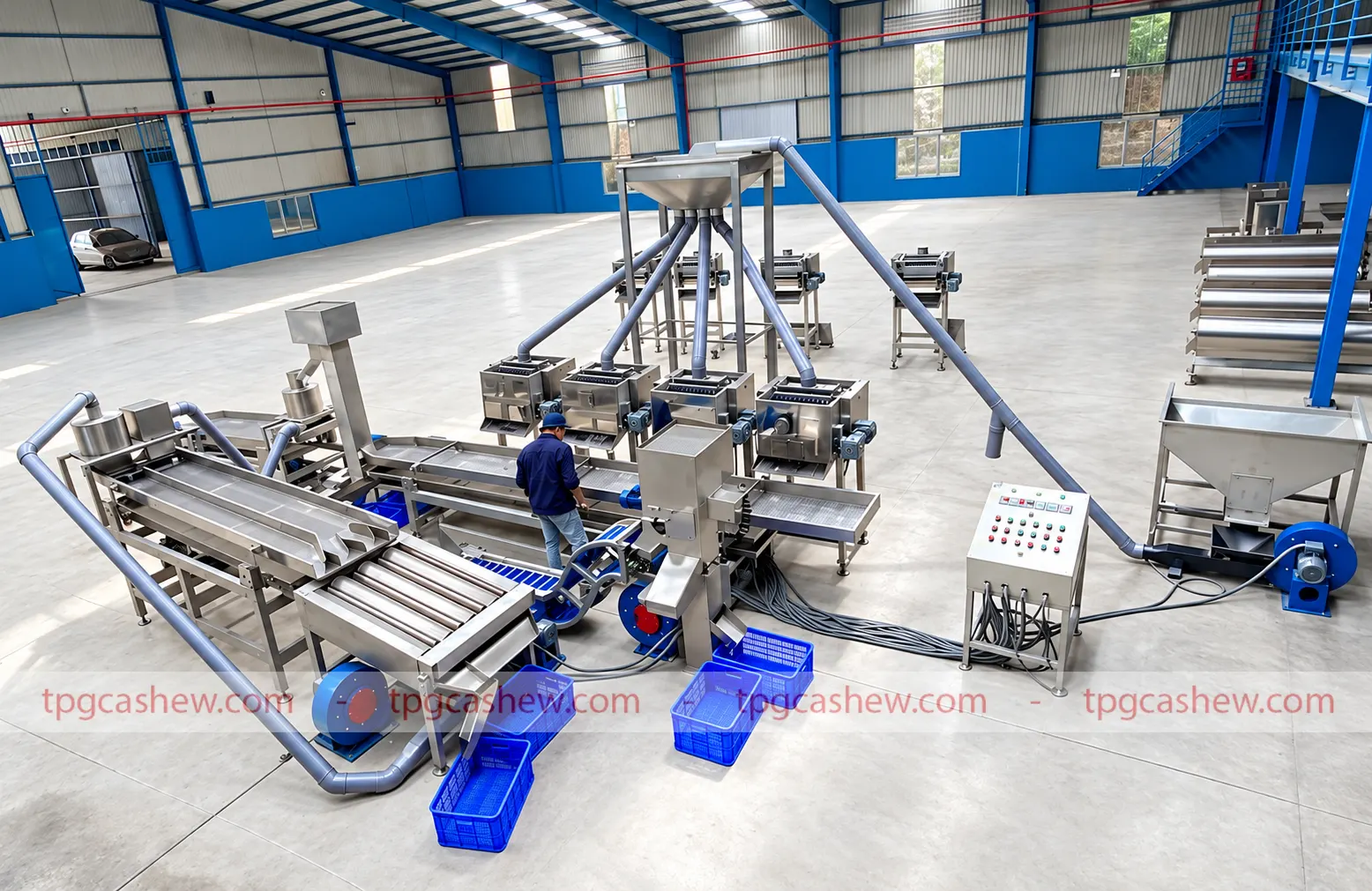
The key difference between a line and a group of machines is integration. Capacities are balanced between stages, conveyors and buffers are placed where the process needs them, and the settings of one machine take into account what the previous machine delivers.
The Five Stages of a Cashew Processing Line
Stage 1: Raw Nut Receiving and Calibration
Everything starts with the raw nuts. Before they enter the line, they are cleaned, checked for moisture and impurities, and stored under proper conditions. Nuts that are too wet, moldy or full of foreign material cause problems in every stage that follows.
The next step is calibration, which means sorting nuts by size. A cashew calibrator separates the raw nuts into size groups so that each group can be processed with its own machine settings. This matters because the shelling mechanism works best when the nuts it handles are similar in size. Mixed sizes lead to more broken kernels and more uncut nuts.
Good calibration is one of the cheapest ways to improve whole-kernel recovery. You can read more about how it works in our guide to the cashew calibrator.
Stage 2: Steaming and Conditioning
Raw cashew shells are hard, and the shell structure contains a caustic liquid. A controlled steaming and conditioning step prepares the nut for shelling by changing the condition of the shell and the kernel inside.
The goal is consistency. If steaming is uneven, some nuts will be too hard to cut cleanly and others will be too soft, which raises breakage. A well-designed steaming system gives stable temperature and treatment time, so the shelling stage receives nuts in a predictable condition.
When planning this stage, consider steam supply, treatment time, energy use and how easily the system can be adjusted for different nut origins. Our cashew steaming system is designed around these points.
Stage 3: Shelling and Separation
This is the stage most people think of first. A cashew shelling machine opens the shell and releases the kernel, ideally in one piece. After shelling, the mixture contains kernels, broken shell pieces and uncut nuts, so a separation step removes the shell material and returns uncut nuts for another pass.
What to look for in this stage:
- Stable throughput: the machine should hold its capacity during long shifts, not only in a short demonstration.
- Kernel protection: the cutting or opening action should minimize broken kernels, because whole kernels sell at a much higher price than pieces.
- Clean separation: shell fragments left in the kernels create extra work in later stages and can hurt final quality.
- Ease of maintenance: cutting parts wear out, so fast replacement and adjustment keep downtime low.
Details of our shelling equipment are on the cashew shelling machine page.
Stage 4: Drying and Humidification
After shelling, kernels are still covered by a thin brown skin called the testa, and they hold moisture that makes the skin stick. Drying reduces that moisture in a controlled way so that the skin can be removed in the next stage. If drying is too aggressive, kernels become brittle and crack. If it is too light, peeling becomes difficult and efficiency drops.
Humidification then brings the kernels back to a stable moisture level, helping prevent cracking and keeping them in good condition before peeling. Temperature, airflow and time need to be controlled and recorded, since small changes can affect the final kernel quality.
Stage 5: Peeling, Grading and Packing
In the final stage, the testa is removed by peeling, either by mechanical or air-based equipment, sometimes combined with manual finishing. The peeled kernels are then graded by size, shape and color into commercial grades such as whole kernels, splits and pieces. Grading accuracy directly affects the price you receive for each batch.
Finally, kernels are packed according to your customers’ requirements, for example in vacuum or gas-flushed packaging to protect freshness during storage and shipping.
Why Integration Matters More Than Individual Machines
Many factories start by buying one machine at a time. This can work, but it often leads to hidden problems:
- Capacity mismatch: one stage becomes a bottleneck and the rest of the line waits.
- Inconsistent material flow: nuts or kernels arrive at the next machine in a condition it was not designed for.
- Divided responsibility: when quality drops, each supplier points to another machine.
- Layout limits: machines bought separately may not fit together in the available space.
A turnkey approach solves these by designing the whole line around your capacity target, raw material characteristics, product goals and factory layout. That is how TPG Cashew approaches projects, and you can see our approach on the Solutions page.
How to Plan Your Cashew Processing Line
Before you contact a supplier, prepare answers to these questions. They shape the whole design.
- What is your target capacity? Define daily or hourly raw nut input, and think about future expansion.
- Where does your raw material come from? Nut size, shell hardness and moisture differ between origins, and machines should be configured accordingly.
- What products do you plan to sell? Whole kernels, splits or value-added products require different grading and packing setups.
- How much labor will you use? The balance between manual work and automation changes both investment and operating cost.
- What space and utilities are available? Steam, power, water and floor area limit the layout.
- What quality standards must you meet? Export markets may require specific food safety and traceability practices.
A good supplier will ask you these questions before quoting, not after.
What to Look for in a Cashew Machinery Manufacturer
- In-house engineering and manufacturing, so design, fabrication, assembly and testing are controlled in one place.
- Ability to customize machines for your raw nuts, not only sell catalogue products.
- Complete line experience, not just single machines.
- Installation and technical support, including training and spare parts planning.
- Reference projects you can review.
TPG Cashew designs and manufactures its equipment in Vietnam, with more than ten years of engineering focus on cashew processing machinery. You can learn more about our manufacturing capability and see recent projects.
Common Mistakes When Building a Cashew Processing Plant
- Choosing machines based only on price instead of whole-kernel recovery and running cost.
- Skipping calibration or using it as an afterthought.
- Ignoring moisture control before and after shelling.
- Underestimating spare parts and maintenance needs.
- Not leaving room in the layout for future capacity growth.
Frequently Asked Questions
What machines are in a cashew processing line? A typical line includes a calibrator, a steaming system, a shelling machine with separation, drying and humidification equipment, a peeling machine, grading equipment and packing equipment. The exact configuration depends on your capacity and product targets.
Can I start with individual machines and expand later? Yes. Many processors begin with key machines such as calibration, steaming and shelling, then add other stages. It is best to plan the full line layout from the start so later additions fit properly.
How long does it take to deliver a complete line? It depends on capacity, customization and the status of your factory building. Contact us with your requirements so we can give a realistic schedule.
Do you support installation outside Vietnam? Yes. TPG Cashew provides technical support from project planning through installation and long-term operation for international customers.
Talk to Our Engineers
If you are planning a new cashew factory or upgrading an existing one, our team can help you define the right configuration for your raw material and production goals.
Discuss your processing line or request a quotation today.
